Image

The ACADIEN CRABBERS’ ASSOCIATION is an organization representing most of the midshore snow crab fleet active in the Southern Gulf of St. Lawrence (Canada). Our fishery is encountering an ever-increasing presence of North Atlantic right whales on our fishing grounds and we are actively trying to adjust our fishing gear and practices to prevent harmful interactions with the whales. Through government funding and with the expertise of local and international specialists, solutions are sought through 15 subprojects related to:


Based in Halifax, Nova Scotia, and incorporated in April 2018, Ashored is focused on improving the sustainability of the commercial fishery through the development of user-friendly and purpose-built innovations. Currently, Ashored is addressing issues of marine animal entanglements, derelict/ghost fishing gear, and the related challenges to the industry and governance.
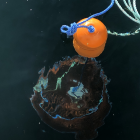
Ashored has developed a ropeless fishing system and accompanying tracking software that can be used with current industry traps/trawls. This gear sinks to the ocean floor and can be recalled to the surface using an acoustic release and time-based redundancy. Once the buoy and connecting rope surface, fishermen can use existing onboard equipment and processes to retrieve the traps and prepare for redeployment. By preventing fixed ropes from extending throughout the water column, marine life will be able to pass through fishing waters without harm and fishing ropes will no longer be susceptible to being severed by boat propellers or competitors.
Ashored’s proprietary rope containment system facilitates simple loading and resetting, and also fast, clean rope release that helps fishers minimize gear losses and prevents potential entanglements with marine animals. Ashored’s ropeless fishing systems are designed for the harshest conditions and take into account key factors prioritized by fishers.
The New England Aquarium’s BalanceBlue Lab (BBL) is going beyond research to pilot, implement, and scale solutions that support ocean industry and ocean health. By advising and partnering with businesses and decision-makers, BBL helps ensure that the blue economy—from seafood to shipping—can grow responsibly while safeguarding the ocean and all who rely on it.
Central Wharf
Boston, MA 02110 USA
The Centre for Sustainable Aquatic Resources (CSAR) is an applied research unit within the School of Fisheries at the Fisheries and Marine Institute, Memorial University. Recognized as Canada’s experts in fish capture, our team has core strengths in fishing gear design and testing, conservation engineering, fisheries biology, fish capture behaviour, and mechanical engineering. The team uses a combination of numerical simulation, physical modelling in the flume tank, and at-sea comparative fishing experiments to improve sustainable fishing practices and profitability of commercial fishing enterprises.